Workflow guide
Decision-Native Computing: Why Tomorrow's Software Separates Judging from Generating
Why the future of software has two distinct AI calls: Generation Calls (to produce text) and Decision Calls (to choose which code branch to run). How HA-Jev, Kev (0.5B on-device), and the Decision Runtime pattern turn sensor states into real-world automated actions.
Step 1
Two kinds of AI calls: Writing essays vs. flicking switches
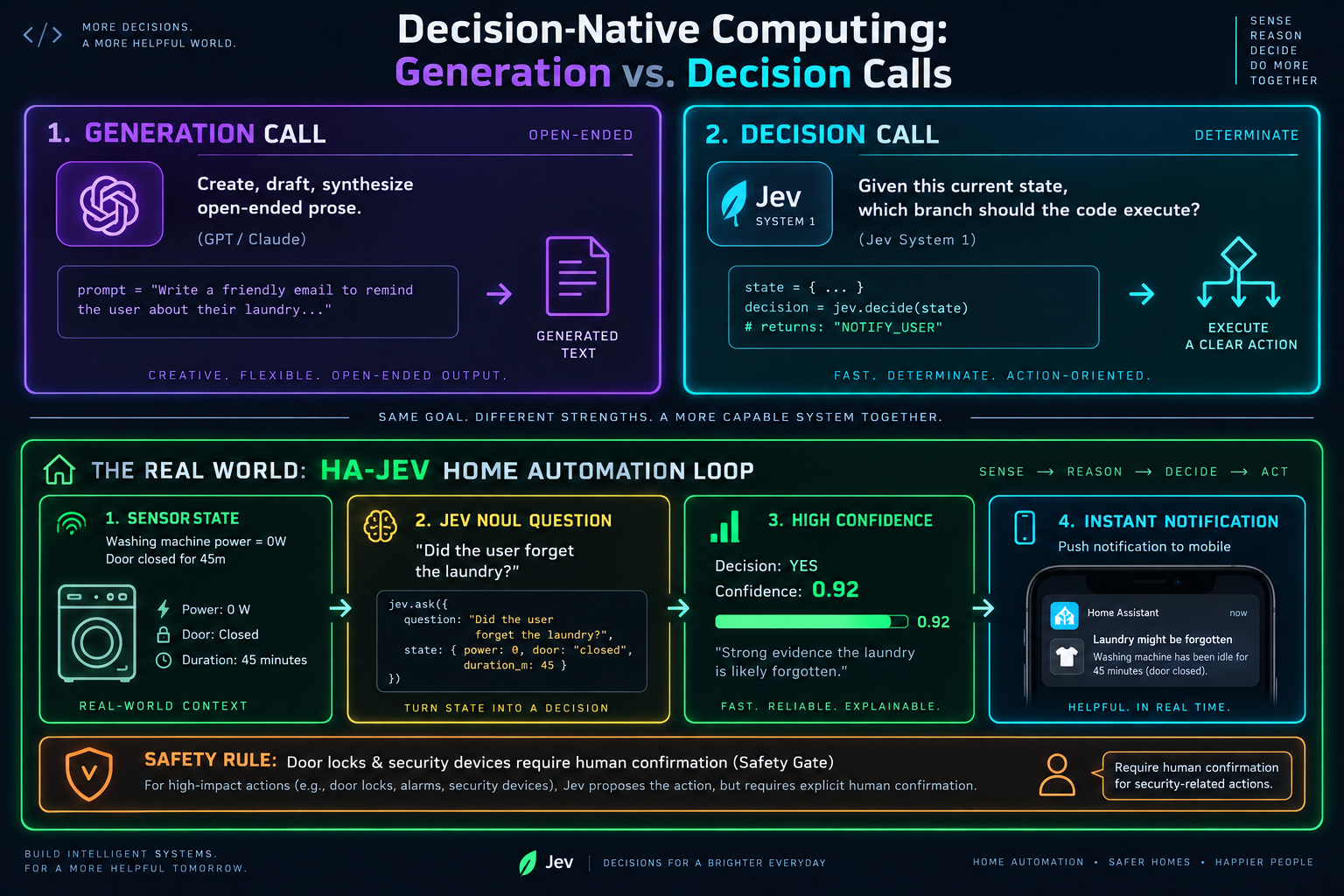
Most people think AI is only for drafting emails, synthesizing documents, or generating code patches—these are open-ended Generation Calls where heavy models spend seconds producing prose. But production software and hardware (IoT, CRM, factories, trading engines) rarely need prose; 99% of the time, they only need a Decision Call: should we notify the user? Is this sensor anomalous? Which branch should the code execute?
Step 2
The washing machine loop: Real-world HA-Jev home automation
The open-source project HA-Jev provides a textbook proof-of-concept for Home Assistant: device telemetry is fed as Jev state—'power = 0W, cycle completed 45 minutes ago, door = closed'. Instead of an expensive LLM writing a chat response, Jev answers a single Noul question: 'Did the user forget the laundry?' Jev returns a decisive 0.92 probability in milliseconds, triggering an instant mobile push notification.
{
  "model": "systemone",
  "state": "Appliance: Washing Machine. Power: 0W. Cycle status: finished 45 minutes ago. Door state: closed.",
  "questions": [
    {
      "type": "noul",
      "id": "laundry_forgotten",
      "instruction": "Based on the idle power and closed door after cycle completion, did the user likely forget the laundry?"
    }
  ]
}
Step 3
The critical safety gate: Never let AI unlock doors unattended
If an AI errs on forgotten laundry, the inconvenience is trivial. If an AI errs on unlocking a physical door or transferring funds, the impact is catastrophic. HA-Jev demonstrates the vital Safety Gate rule: low-risk actions execute automatically at high confidence; but high-risk operations (e.g. door locks, alarms, file deletions) are strictly intercepted to require explicit human PIN confirmation.
{
  "model": "systemone",
  "state": "Event: Visitor detected at front door. Recognized face: family member (confidence 0.81). Action requested: unlock_front_door.",
  "questions": [
    {
      "type": "choice",
      "id": "lock_action_policy",
      "instruction": "Evaluate security risk for this automated door unlock request.",
      "options": [
        {
          "id": "auto_allow",
          "label": "Low risk, allow automatic unlock"
        },
        {
          "id": "require_pin",
          "label": "High security asset, require user passcode verification"
        },
        {
          "id": "block",
          "label": "Unrecognized or dangerous, block completely"
        }
      ]
    }
  ]
}
Step 4
Offline on-device: 0.5B tiny models (Kev) make decisions local and free
Jev's System One interface is becoming a software paradigm. Projects like Kev (by Jared Palmer) package Qwen 0.5B/0.8B with a custom readout head that runs on a Mac, iPhone, or edge device without internet. In SemIf benchmarks on an RTX 3090, reading option logits directly without token generation delivers a 5.2x systems speedup over traditional JSON-generating models.
Step 5
The Decision Runtime pattern: Pluggable backends with policy gates
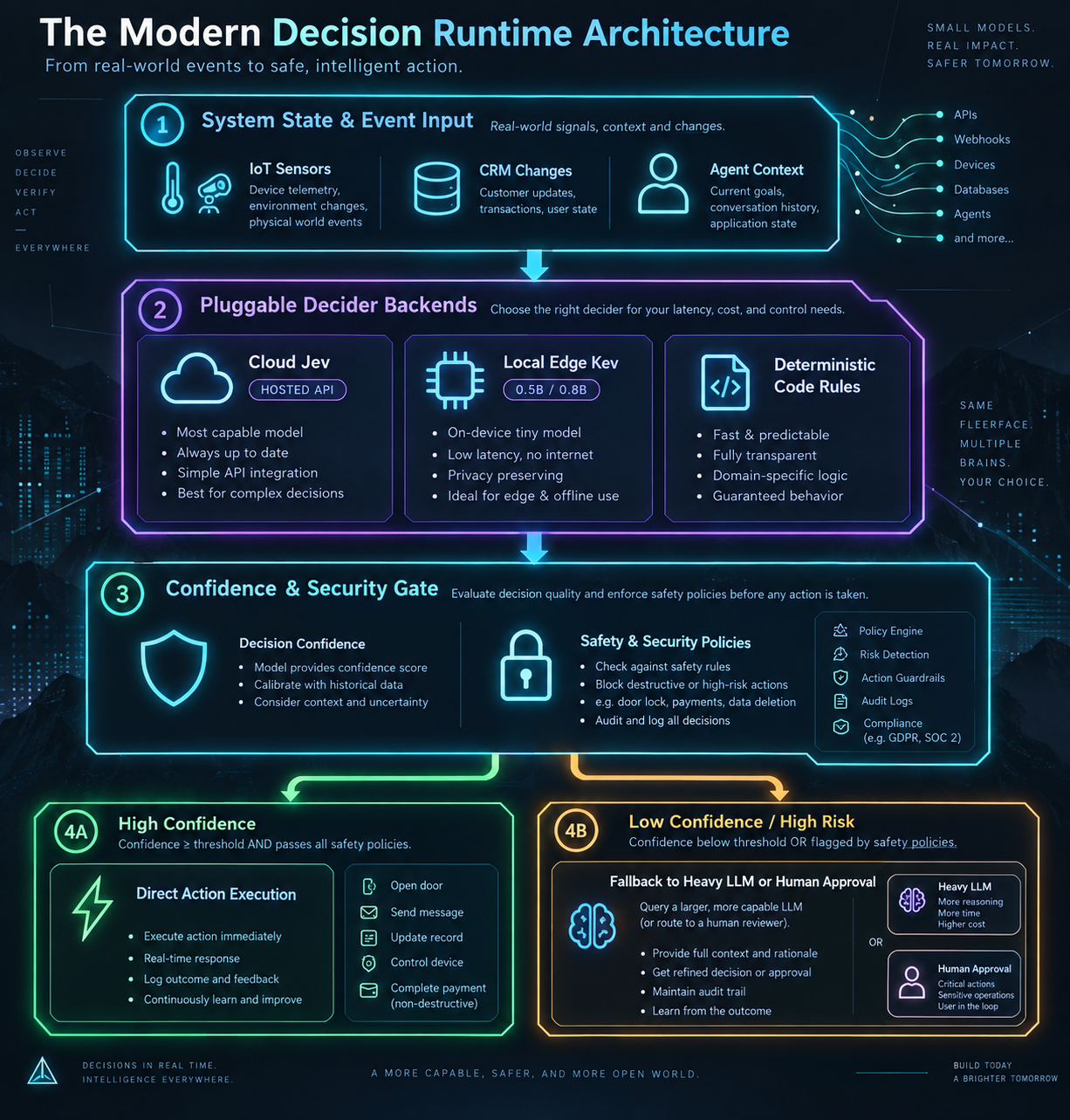
Modern software architecture is adopting the Decision Runtime: upstream sensors and events feed into an engine that dynamically routes questions to hosted cloud Jev, local edge Kev (0.5B), or deterministic code rules. A unified Confidence Gate and Security Policy layer evaluates every verdict—high-confidence safe actions execute instantly, while uncertain or high-risk actions escalate to heavy LLMs or human reviewers.
Step 6
Universal applicability: Swap the washing machine for your business
The washing machine loop is not just a smart-home novelty. Replace the appliance telemetry with CRM customer churn signals, server latency spikes, construction site camera alerts, or e-commerce refund requests. The architecture remains identical: Sense state -> Decide branch -> Enforce gate -> Act. Decoupling fast decisions from slow generation makes your entire product lightning fast.
Related projects
- @typesafe-ai/sdk — Official TypeScript/JavaScript client for POST https://api.typesafe.ai/v1/systemone.
- jev-sentinel — Pi, Claude Code, and Codex CLI guard that asks Jev whether a tool call is on-task, risky, or injected before it runs.
- fast-jev-compaction — Claude Code plugin and npm library that asks Jev which tool calls to keep, instead of summarizing the transcript.